The global push toward lightweight composite structures, industrialized manufacturing, and circular design is accelerating across the composites industry. This shift was highlighted at the JEC Forum DACH in Dresden, where the 2025 AVK Innovation Awards recognized groundbreaking developments in products, processing technologies, and scientific research. At the same time, the upcoming Expo 2025 Osaka—particularly the iconic Blue Ocean Dome—demonstrates how advanced composite materials can redefine architectural engineering.
For manufacturers of high-precision tooling such as SMC molds and composite molds, these innovations provide new opportunities for application, design optimization, and sustainable development.
1. Innovation Landscape: Lighter, Cleaner, and More Industrialized Composite Technologies
The AVK Innovation Awards emphasize composite solutions that reduce weight, improve recyclability, and strengthen industrial-scale production. Three main categories—products & applications, processes & methods, and research & science—highlighted how the composite industry is transforming.
1.1 Breakthrough Applications: 3D Printing, Aerospace, and Fire Safety
Zeisberg Carbon secured the category’s top prize with its 3D-printed fiber-reinforced thermoplastic mold system, produced using one of Germany’s largest industrial printers (6 × 2 × 3 m). The system integrates recycled materials, automated production, and minimal waste—showcasing the direction in which future composite mold fabrication is heading.
In aerospace, Invent, Nord-Micro, and KOHPA developed a carbon-fiber heating system integrated directly into composite ventilation ducts. By replacing metal heaters, the system reduces weight, fuel consumption, and emissions, while passing DO-160 certification after 3,300 hours of testing.
3D|CORE’s FR Sealing™ introduced a fire-resistant polymer–mineral foam that eliminates the need for manual fiberglass layers. Certified to IMO FTP 2010 and EN 45545-2 HL3, it provides an efficient, lightweight solution for rail and marine structures.
1.2 Circular Processing: Chemical Depolymerization and Fiber Optimization
SECARA won for its ability to chemically depolymerize engineering plastics (PA, PC, PBT) into high-purity monomers, reducing CO₂ emissions by 70% and reintegrating them into existing industrial chains—offering new pathways for recyclable composite matrices.
The Leibniz Institute for Polymer Research (IPF) and TU Dresden demonstrated ultra-lightweight CFRP structural parts created with customized fiber placement, producing a 183-gram suspension arm capable of 5 kN loading—a 40% weight reduction compared with titanium.
Amiblu Germany introduced a closed-loop system reusing over 90% of GRP grinding dust annually, saving 4% calcium carbonate and significantly cutting industrial waste.
1.3 Scientific Advances: Reversible Bonding and High-Performance Recycling
The Recreate Project, involving Edag Engineering, Invent, Fraunhofer IWU, and Applus+ Rescoll, developed thermally reversible bonding for composite structures, enabling non-destructive disassembly and material reuse—an important milestone for circular composite architecture.
Fraunhofer IPT’s Tape-REx process allows non-destructive recovery of UD thermoplastic tapes while preserving fiber integrity, making the recycled material suitable for automated fiber placement and compression molding.
FIBRE and STFI introduced a continuous hot-forming method for recycled CFRP organosheets, enabling aerospace-grade, variable-thickness components in a single integrated process.
2. Lightweight Architecture at Expo 2025 Osaka: CFRP as a Structural Game-Changer
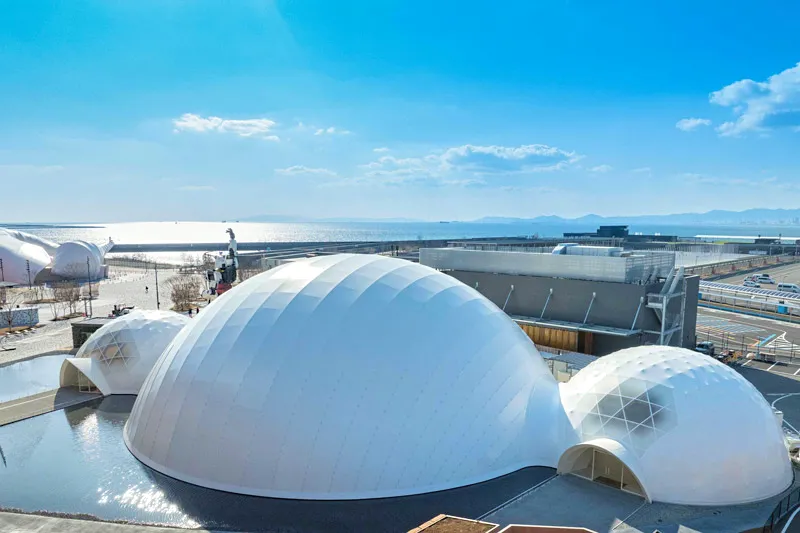
One of the most compelling real-world demonstrations of advanced composite engineering is the Blue Ocean Dome at Expo 2025 Osaka, designed by renowned architect Shigeru Ban. The Expo site—Yumeshima Island—has limited soil-bearing capacity, restricting excavation to just 2.5 meters and rendering traditional deep foundations impractical. This constraint provided the perfect opportunity for CFRP lightweight structures.
2.1 A Three-Dome Architecture Built on Circular Design Principles
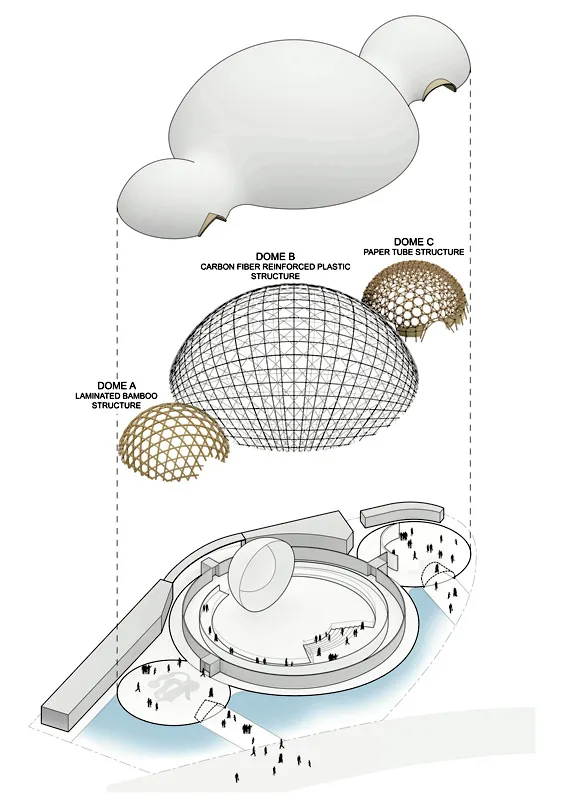
The Blue Ocean Dome complex consists of three interconnected domes, each constructed using a different sustainable material:
- A-Dome: Laminated bamboo (20 m span)
- B-Dome: CFRP structural tubes (40 m span)
- C-Dome: 100% recycled paper tubes
The B-Dome is particularly significant: it represents Japan’s first seismic-resistant architecture using CFRP tubes and one of the world’s earliest full-scale composite dome structures of this span.
2.2 Why CFRP Matters: Strength, Stiffness, and Extreme Lightness
Carbon fiber reinforced polymer (CFRP) provides:
- 5× the tensile strength of steel
- 2× the stiffness
- A fraction of the weight
Remarkably, the total weight of the B-Dome is less than the soil removed to prepare its foundation. This made it possible to construct the dome without deep piles, significantly reducing construction time, material usage, and environmental impact.
2.3 Engineering the Dome for Global Relocation
After the Expo, the entire structure will be dismantled and relocated to the Maldives for use in a marine conservation initiative. This required extensive thermal and humidity simulations to ensure structural stability in a hot, humid climate.
Engineers adopted a hybrid system combining:
- CFRP tubes as the internal load-bearing frame
- Steel sub-frames supporting the membrane structure
- Modular, detachable joints enabling circular reuse
The design confirms that composites do not replace conventional materials—they enhance them, creating optimized multi-material structural systems.
3. Implications for the Composite Mold Industry
The Blue Ocean Dome and the latest composite innovations reinforce several key market trends highly relevant to manufacturers of SMC molds, compression molds, and large-format composite tooling.
3.1 Growing Demand for Precision Composite Tooling
As lightweight structures become more advanced, high-precision molds are required to achieve:
- controlled fiber orientation
- high-quality surface finish
- tight dimensional tolerances
- stable temperature and pressure environments
Such requirements directly increase the demand for advanced composite mold manufacturing capabilities.
3.2 Composites Expand into Architecture and Civil Engineering
The success of the CFRP dome invites broader architectural applications, including:
- large-span roofs and shells
- modular building components
- prefabricated composite panels
- structural tubes and connectors
These applications require robust molding solutions that support both thermoset and thermoplastic composite systems.
3.3 Circular Manufacturing Will Drive Future Tooling Design
Composite mold manufacturers will increasingly integrate:
- recyclable mold materials
- energy-efficient curing cycles
- compatibility with recycled fibers and resins
- modular tooling systems for shorter product cycles
This aligns with global sustainability expectations and supports long-term competitiveness.
Conclusion: Composites Are Redefining the Built Environment
After observing both the AVK Innovation Awards and the engineering of the Blue Ocean Dome, one trend is indisputable: advanced composites are reshaping the future of architecture, mobility, and industrial manufacturing.
For the composite tooling sector—including SMC mold, CFRP mold, and high-performance composite mold manufacturers—this moment represents an extraordinary opportunity. Lightweight composite structures are no longer conceptual experiments; they are emerging as scalable, practical, and sustainable engineering solutions.
As the world moves toward lightweight and circular construction, Suase Mould remains committed to delivering the precision tooling and engineering expertise required to support the next generation of composite innovation.